
Campfire Moon
The long nights of midwinter are a country, not a void. For this darkness is where we are mended.

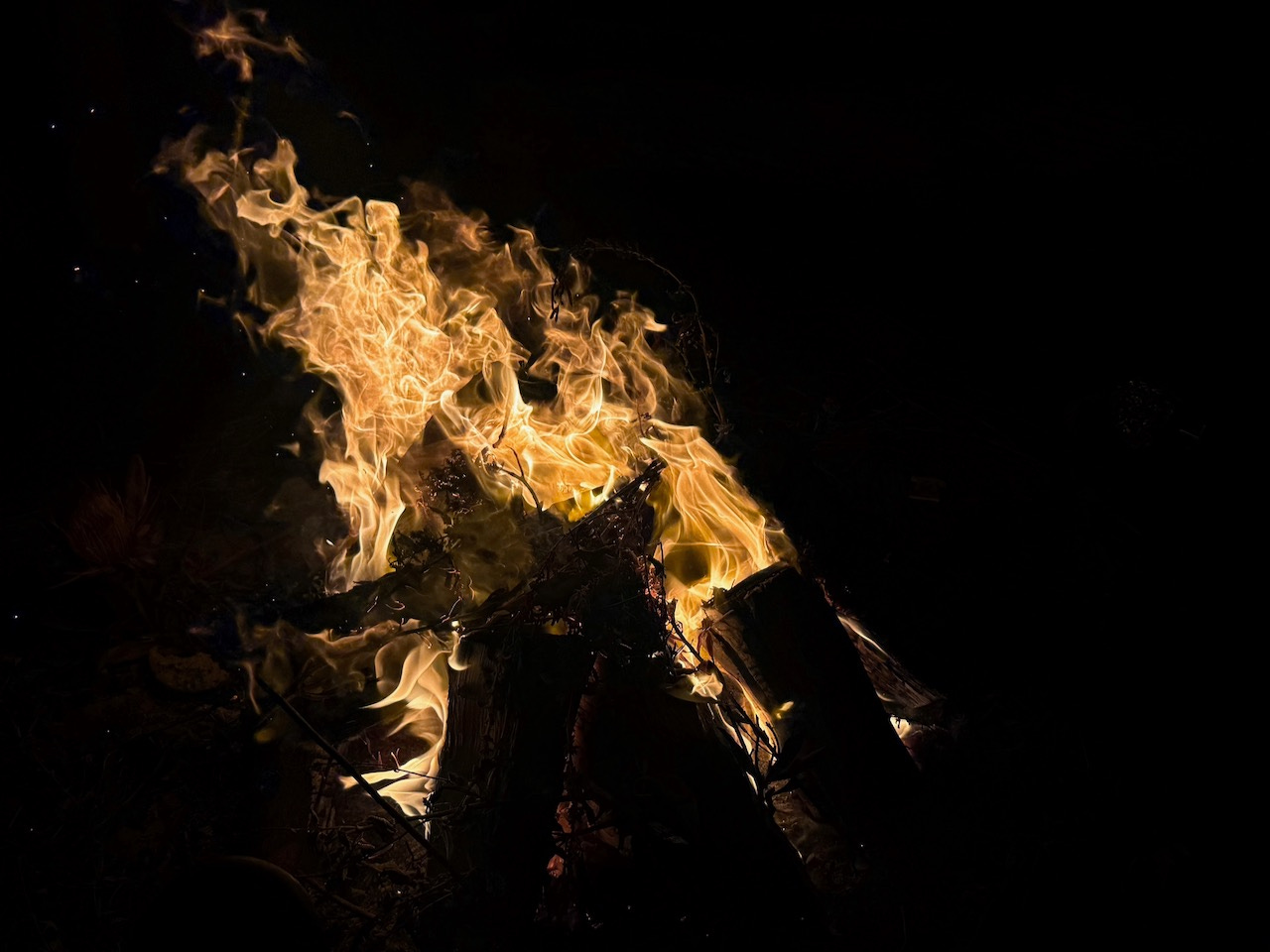
There is a month in the depth of the year when the dark outlasts the light by many hours. The sun leaves early, sliding behind the hills while the afternoon still feels unfinished, and the nights that then unfold are the longest of the whole turning year.
We could call this the dead of winter. People often do. But there is nothing dead about this place. This is the month when darkness is at its fullest blooming - and when the moon, riding high and bright, has the most night sky to cross.
Call this the Campfire Moon: the season of longest nights, when fire and moon together reach furthest into the many hours of darkness the sun has yielded.
It asks something of us, this month. Not to endure the dark, but to come and sit inside this special place.
The dark is its own country
We have learned to speak of darkness as an absence - the nothing that arrives when the light is switched off, the empty hours to be got through until morning.
But darkness is not empty. It is a vast, welcoming country, fully inhabited, with its own citizens and its own hours of action. Moths set their course by the moon. Owls hunt by the smallest sound. Flowers that stay closed all day unfold their pale faces only once the sun is gone, releasing scent into air that no daytime creature will ever smell.
For all of these beings and for so many more, nightfall is not an ending. It is the opening of the day.
And we are night-loving creatures too, in our deep design, more than the sunlit world lets us recall. Our bodies are built to fall every evening into real, deep darkness - and to be mended there, by the lack of light.
Our sleep cycles stitched back together, our inner clocks reset, the long slow housekeeping of cells that can only happen in the dark. Take the darkness away, fill the night with artificial light, and our bodies struggle to stay well.
Darkness is not a blip in the day to be corrected. Darkness is a land that our bodies yearn for.
The sky hungers for this darkness as well. From a place where the night is genuinely black, the Milky Way is no mere sprinkling of stars - it has great depth, and current, and shadow. Across this continent, many First Peoples read a great emu in those dark rivers of the galaxy, a bird shaped not from the bright stars but from the darkness amidst them.
Emu can only be seen in the night sky in places where the night still runs deep. Let the glow of a city leak upward and it is no longer there - not because a single star has fallen, but because the dark that holds the shape of Emu’s body has been washed away.
So this is one gift of the month of the longest nights. Darkness is not a void. It is a habitat, brimming with life and meaning - and mid-winter is the season we can visit darkness most abundantly.
The long bright moon
A simple moonlit fact sits at the heart of this month… the shortest days make for the longest nights! And these longest of nights, when the moon comes round to full, hold more moonlight than any other nights of the year.
The mid-winter full moon does not bumble low along the horizon the way the winter sun does. It does the very opposite. The full moon of winter takes the high road - soaring above in the tallest arc it will reach all year, sailing nearly overhead through the long winter night, from horizon to horizon.
This is true across the world… wherever you stand, the mid winter full moon climbs highest, and stays out longest, pouring its light into the most generous span of darkness in the year.
Hour upon hour - cool, silver, unhurried light - laid out across the frost.
The living world does not flinch from this abundance of moonlight. Plants read moonlight in another language entirely than sunlight; a night soaked in moonglow does not scramble their inner clocks or rob them of rest the way our own electric lights do.
The moon is no intruder upon the dark. It is one of the night’s own - an ancient and trusted member of the household of darkness, woven of the same cloth.
A campfire, lit
To mark this turning of the year, a simple practice. A handful of sticks. A patch of bare ground. A match.
Your campfire need not be grand. It can be the smallest thing - a few twigs caught alight in a courtyard, a single candle on a windowsill, a flame held against the night sky for only as long as it lasts.
The size is not the point. The point is the lighting of it: the deliberate creation of campfire light when the year’s darkness is deepest, and the choosing to stay beside it a while.
This is the oldest midwinter move there is. Older than any calendar, older than the names we give the months. When the cold closes in and the night grows long, we draw close to a campfire, and to one another.
To intentionally sit with firelight is the simplest step beyond an ordinary evening - and it changes the whole character of your night.
What the campfire does to us
Sit down by a campfire after dark and something in you turns over. You can feel it happen, even without a name for it.
Some of it is chemistry. Firelight is just bright enough to hold the body’s melatonin release, and therefore the night’s sleep, at arm’s length - to keep you wakeful a while longer - yet it falls at exactly the hour when no more daylight work can be done.
And so, in our campfire brainstems, at this time of day we are awake and idle at once: alert, unhurried, with nowhere on earth we need to be. In another place.
And the campfire holds the eye in a way few things do. There is a light-looking that drains a person - the hard, fixed glare of a screen.
Campfire offers the other kind. It gathers your gaze and rests it in the same moment, shifting and flaring and never once demanding. You can watch a campfire for an hour and rise from it filled, rather than emptied.
Campfire light alters how we are with one another, too. By daylight we read each other ceaselessly - the set of a shoulder, the whole weather of a face, who stands high and who stands low. Around the campfire, all things grows soft. Bodies become shapes against the dark. Faces blur and flicker.
It becomes hard to tell the important from the unimportant, and so, for a while, the question loses its grip. The day’s long list of grievances are quietly laid down.
Even time changes shape, by firelight.
What is told in the dark
We know, as it happens, a good deal about how humans tend to behave around a campfire after dusk. The anthropologist Polly Wiessner spent many years among the Ju/’hoansi people of the Kalahari and did a thing no one had thought to do before: she set down what was spoken of by day and what was spoken of by night, and laid the two side by side.
In daylight, the talk was working talk. Plans and practicalities, who had done what, the grumbles and corrections and steady ordinary business of holding a group together.
By night, by campfire light only, it nearly all became story. More than four conversations in every five turned to tales - of real people, of far-off places, of things long past and people long gone.
By campfire light, the communal talk loosed itself from the practical and went wandering. It reached for those who were not present, for country beyond the horizon, for the dead and the unseen. The imagination ranged out further than the daylight ever thinks to send it.
Campfire light is the hour for everything that binds people at the level of feeling rather than function - the singing, the dancing, the ceremony, the long tale unspooled by someone who has mastered the telling.
Campfire light seems to be a precious space where the greater shape of how to live together is handed on - not taught so much as told, and felt, and laid down in the body to be carried forward in time and space.
Older than memory, and this is its season
None of this belongs to one people or one place. When Wiessner cast her eye across sixty separate land-based societies the world over, she found the same line drawn through every one.
Night and firelight talk, culture after culture, was given to story, to ceremony, to the imaginal realm. As the Ainu of northern Japan hold it: the day is for our own affairs, and the night belongs to the deities.
Some who study these things now suspect the campfire-lit evening is not really part of the day at all, nor just the threshold of sleep…
…but instead, a distinct third place.
Campfire time is a phase of our body clocks that is entirely its own, one that our minds have been shaped within across hundreds of thousands of years.
A time-place that is neither labour nor rest, but something apart: a time where we perceive the imaginal realm as the most solid reality.
A place for travelling far, in time and space, and drawing the faraway near - all whilst sitting by the fire, together.
And mid-winter is the season when the chance to inhabit this third time-place swells to its greatest becoming.
On the longest nights of the year, the firelit hours spill out across hours that any other season would still count as day. The campfire moon is the month when the oldest part of the human day, this third place, grows longest of all.
Many of us have largely set down the possibility of this third place, in our current way of living.
For most of us the evening no longer fades with firelight sinking to coals but ends with the flick of a switch - the day clapped shut, screen-light carrying us right to the edge of sleep.
No slow hours left in which to turn the day over in our hands and our hearts, to mend what the day has bent, or to let troubles cool and settle with the embers.
But the knowing of that other kind of evening remains. It lies only dormant, not lost - waiting just beneath the surface of any ordinary night, in every lineage there is.
The people we each come from knew this once, every one of them, and used this third place skilfully. It has only been a while.
And you are always welcome to return there.
Back to the fire
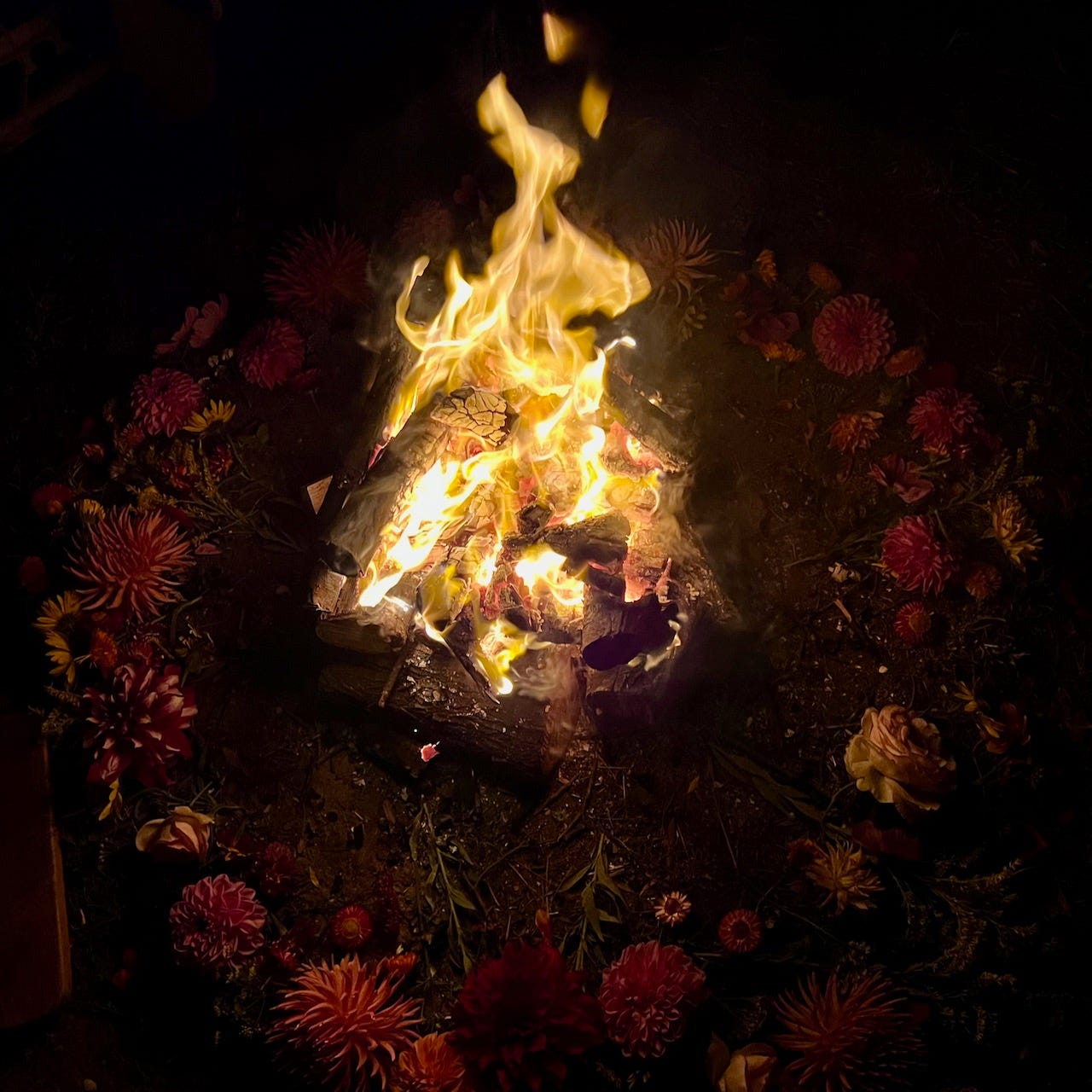
So here is your invitation: lean into the longest of nights, and a small campfire lit for a while - with the moon somewhere overhead, riding its highest road of the year through all those hours in the lands of darkness.
There is no gate-keeping to this practice, and no permission required. A few sticks, warm enough clothes, whatever company gathers - or none, which is its own kind of company.
Strike a match to the tinder. Sit down for a while, and let the campfire do its quiet work upon you. Welcome the darkness in, as the nourishing landscape that it is.
Let your soft fascination hold your gaze within the embers. And let that be enough.
Milkwood is a reader-powered publication written by me, a human. You are welcome to join the conversation:
If you can, please consider becoming a paid subscriber. You’ll be supporting me to keep writing + keeping this journal free for all (yay). Thanks for reading, and be well - K

Another darkness-related read:
Night Mode

Darkness as remnant ecosystem and the ecologies of night are worlds I’m learning to sit with, at the moment.
Sources & further reading
Embers of society: Firelight talk among the Ju/’hoansi Bushmen - Wiessner, P. W. - Proceedings of the National Academy of Sciences
How conversations around campfires came to be - Dunbar, R. I. M. - Proceedings of the National Academy of Sciences
The history of fire use and its effects on human sociality - Attila, Y. - Eurasian Journal of Anthropology
Hearth and campfire influences on arterial blood pressure: Defraying the costs of the social brain through fireside relaxation - Lynn, C. D. - Evolutionary Psychology
Real-ambient bedroom light at night increases systemic inflammation and disrupts circadian rhythm of inflammatory markers - He, Y., et al. Ecotoxicology and Environmental Safety
Whitening the sky: Light pollution as a form of cultural genocide - Hamacher, D. W., De Napoli, K., & Mott, B. - Journal of Dark Sky Studies
Interference of moonlight with the photoperiodic measurement of time by plants, and their adaptive reaction - Bünning, E., & Moser, I. - Proceedings of the National Academy of Sciences
The restorative benefits of nature: Toward an integrative framework - Kaplan, S. - Journal of Environmental Psychology
This is fascinating! Daytime for practical talk and evening for story. I guess even watching TV and scrolling through social media is a diluted form of listening to stories. May we all find our way back to stories around fire and candlelight. For the last 8 or 9 years, my family (mostly) eats dinner around candlelight during the dark months and it helpful tremendously with my Seasonal Affect Disorder. Great post!
There is nothing more satisfying than tending a fire, nothing more transcendent than staring into its embers and flames. 🙏